
Avatar: The Last Self-Bender
Masking, Masquerade, and the Ritual of Black Becoming

Masks don’t conceal. They reveal.
In African and Diasporic traditions, masking is not about hiding. It’s transformation. It’s ritual. It’s revolt. This essay explores the mask not just as an object of art, but as a method of becoming. Drawing on my own work, Yoruba cosmology, and the legacy of Caribbean carnival, I reflect on masking, naming, and the avatar as tools for shaping Black subjectivity across time, space, and performance.
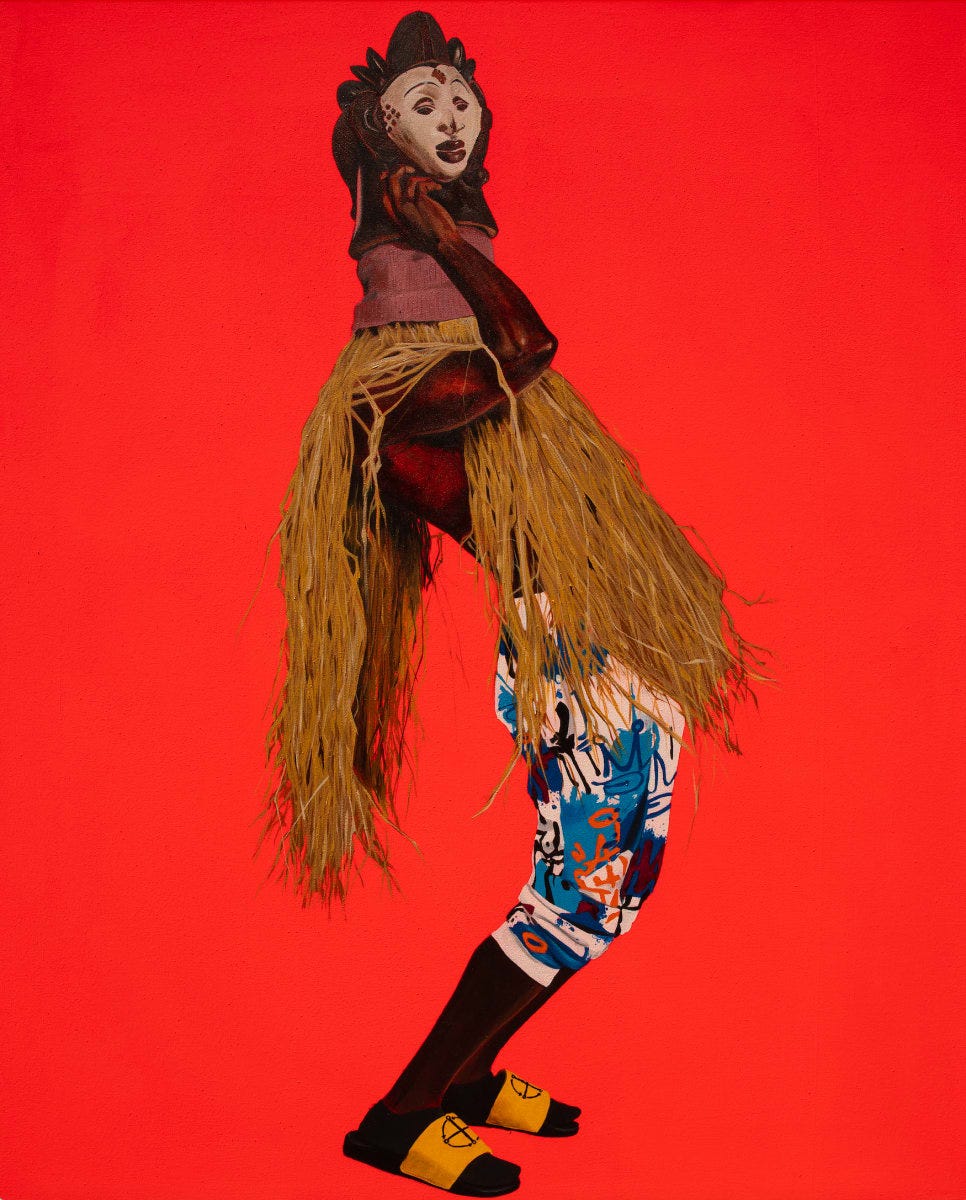
The Power Unseen
I’ve always been drawn to masks.
Not the Halloween kind. Not the pandemic kind. I’m referring to those masks that stop you with their peculiar features. The ones that jolt and jar. The ones that smell as old as they look, earthy, elemental, charged. The ones that dance, sing, channel spirit. African masks: living vessels of memory, energy, and vision.
When I was first introduced to egungun — the Yoruba masking tradition tied to ancestral communion, I was struck by the phrase’s meaning: “the power unseen.” These masks don’t conceal. They reveal. They allow us to experience forces, memories, and truths that lie just beyond our 3-d world.
Across the African Diaspora, masking is a multidimensional practice: a spiritual technology, a political strategy, a social intervention. Through ritual, satire, dance, and pageantry, it transforms trauma into testimony, pain into performance, survival into celebration.
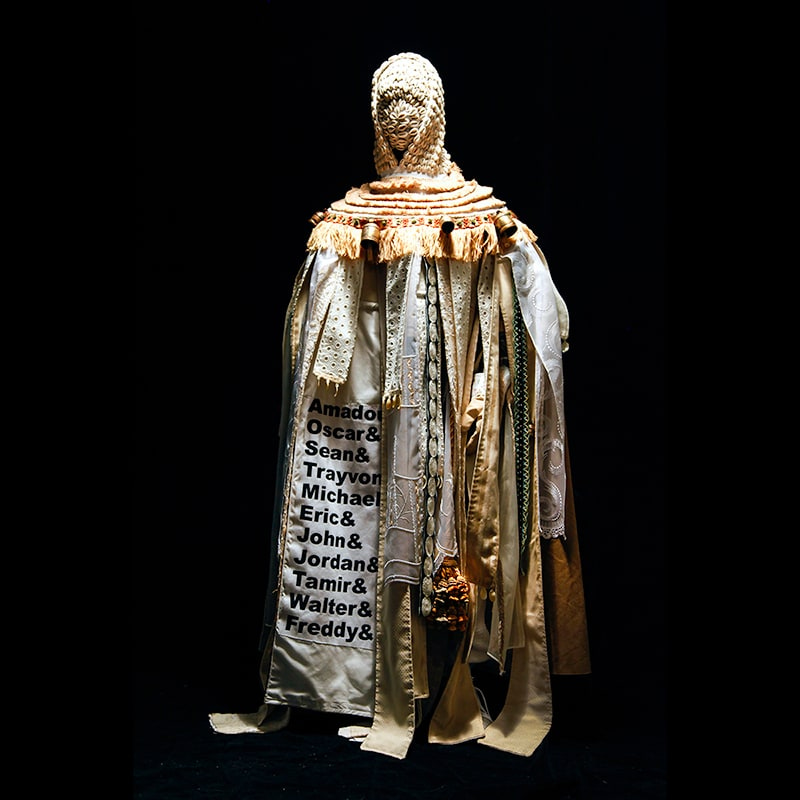
Carnival traditions like Junkanoo in the Bahamas or Jonkonnu in Jamaica — as detailed in exhibition and catalog, EN MAS’: Carnival and Performance Art of the Caribbean — illustrate how masquerade became a site of political agency and radical self-articulation . In these forms, the body is both canvas and message, hidden and heightened.
Scholars like Krista Thompson and Claire Tancons argue that Carnival, often dismissed as mere spectacle, is in fact an evolving form of Black avant-garde — one born not in galleries, but in the streets, the sugar fields, the shipping ports, and the sacred grounds .
In my work, I approach masking as an afrotrope — a recurring symbol or device in Black expressive culture. Afrotropes are not static motifs. They are tools of survival, connection, and play.
The title of this essay borrows from pop culture — Avatar: The Last Airbender — but here, the Avatar is the Black self, and the elements are memory, trauma, joy, performance, spirit. To “bend the self” is to reconfigure identity — to resist the gaze, to remix lineage, to perform futurity.
In this way, masking becomes a way to hold multiplicity without fragmentation. It allows us to shift without losing center.
Self-naming is one of the most potent forms of masquerade.
Think of Shawn Carter becoming Jay-Z. Or Calvin Broadus transforming into Snoop Dogg. Or anyone who’s ever become “L-Boogie,” “Man-Man,” or “Big Rube” for the sake of art, safety, comedy, or ceremony.
These aren’t just aliases. They are masks — linguistic avatars. They are one of the ways we encode aspiration, power, and play into the performance of self.
People often ask why I paint self-portraits.
The truth is: I don’t.
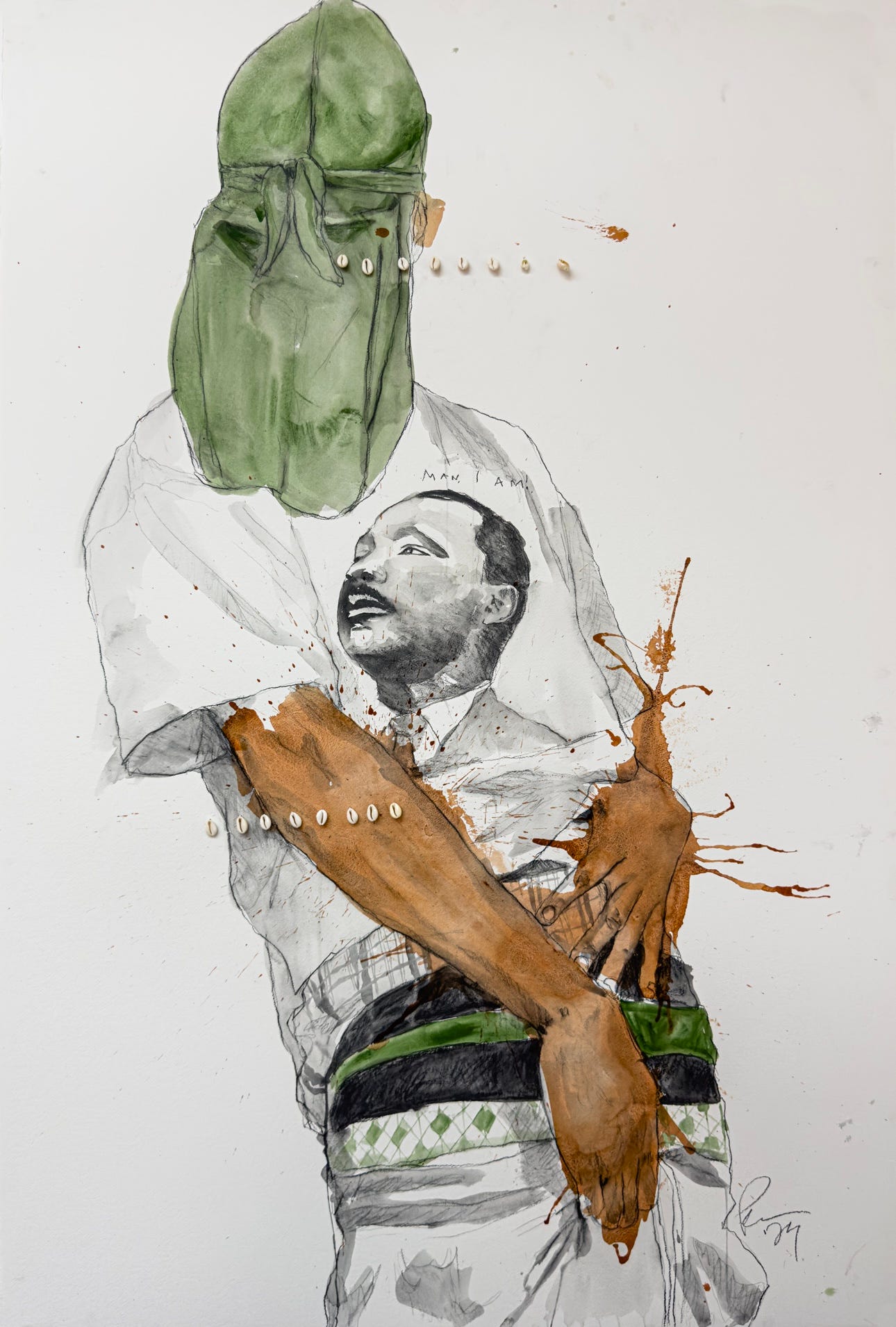
Yes, I use my body in the work. But that figure is a composite. The sunglasses, the fashion, the form is fluid, adaptable. A metaphor. It is not Dr. Fahamu Pecou. It is a mask. A vessel. An idea made flesh.
I stretch the self into something beyond the biographical. In doing so, I connect to masking traditions throughout the diaspora. The mask does not hide who we are; it reveals what lives beneath the surface. It is a language that supersedes speech.
As EN MAS’ reminds us, masquerade provides “a momentary method of freedom”, a chance to abandon the defined self and embrace the many selves within us. It is a diasporic archive, a technology of presence, a celebration of complexity.
Through my own masks, be they visual, verbal, or conceptual, I do not simply depict myself. I invite the viewer to witness an idea made manifest. The mask, as always, is both symbol and ceremony.
Whether through traditional masquerade or contemporary self-fashioning, the mask persists as a method for navigating the world while maintaining connection to the something beyond, something greater than the self. Through it, we don’t escape identity… we expand it.